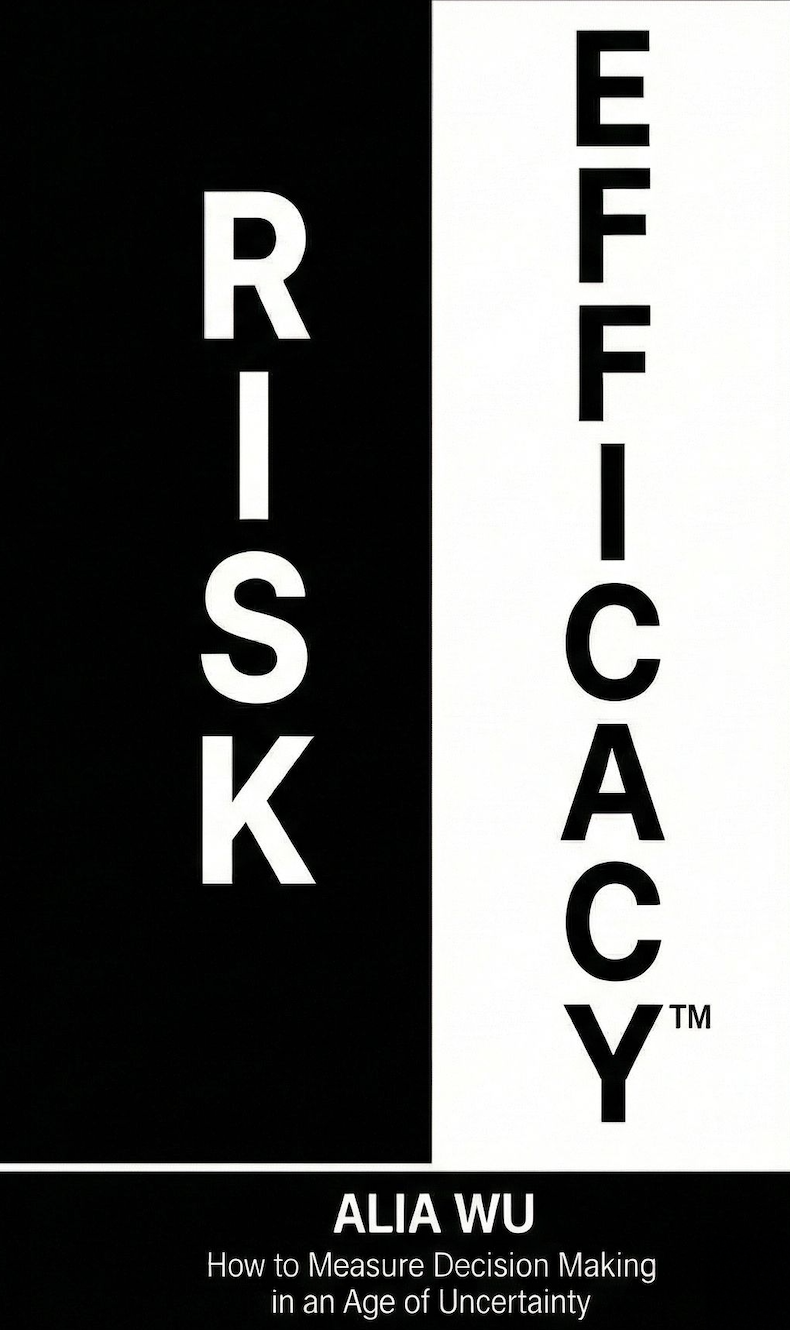
Risk Efficacy™
Measuring Decision Quality Under Uncertainty
If you cannot accurately measure who makes good decisions under pressure, you cannot build a functioning meritocracy. Risk Efficacy™ provides the measurement framework: assessing decision-making capability through Calibration, Informed Navigation, Resilience, and Outcome Achievement.
We like to think we live in a meritocracy, that the most skilled rise to the top. But a true meritocracy requires measurement infrastructure. You need ways to measure merit that actually track what matters.
In domains where performance involves complex decision-making under uncertainty, our measurement infrastructure is primitive. We use proxies (outcomes, credentials, reputations) that are only loosely correlated with actual decision-making ability. And these proxies are systematically biased in predictable ways.
Risk Efficacy™ solves what you might call the merit recognition problem in uncertain environments. The framework measures decision-making as a process: how people gather information, how they handle uncertainty, how they execute, how they recover, and how well their confidence aligns with reality. It emerged from ten years of observation across high-stakes domains (quantitative trading, trauma medicine, professional motorsport), synthesized with research from cognitive neuroscience, judgment and decision-making, and organizational psychology.
The most interesting finding, and the one that gives this work its urgency, is that certain patterns of excellent decision-making are systematically misunderstood. We tend to celebrate bold clarity: decisive, confident, intuitive. We undervalue calibrated precision: methodical, evidence-driven, process-oriented. Both can be excellent. But our systems only recognize one.
What's Inside
What We Can't See
The invisible gap between decision quality and outcome quality in uncertain environments.
The Silent Components
The dimensions of decision-making that current systems fail to measure.
The Calibration Gap
How well your confidence predictions match reality, and why most systems reward overconfidence.
Informed Navigation
Gathering and integrating relevant information while explicitly accounting for uncertainty.
Resilience: From Adaptation to Recovery
How decision-makers respond to setbacks, adapt under pressure, and recover from failure.
Outcome Achievement: Beyond Results
Measuring the quality of the process, not just the quality of the outcome.
The Integration of Pillars
How the four dimensions combine into a complete picture of decision-making capability.
From Theory to Practice
Translating the Risk Efficacy™ framework into deployable measurement systems.
Building Measurement Systems
Designing infrastructure that captures decision quality at organizational scale.
Recognizing Merit in Uncertainty
How to identify genuine skill when outcomes are noisy signals.
Cultivating a Culture of Risk Efficacy™
Organizational transformation toward process-oriented evaluation.
Scaling the Architecture
Taking Risk Efficacy™ measurement from proof-of-concept to enterprise deployment.
The Future of Decision-Making
Where measurement science, AI, and meritocratic infrastructure converge.